Posts

Showing posts with the label FDTD

RFID Tag and Reader Antenna Design Techniques

RFID stands for Radio-Frequency Identification. The RFID device provides a unique identifier for that object and just as a bar code or magnetic strip the RFID device must be scanned to retrieve the identifying information. More Detail: Microstrip and Printed Antenna Design
Image
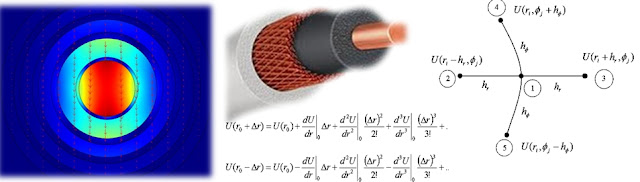
Higher ORDER MODE ANALYSIS USING FINITE DIFFERENCE Coaxial waveguides and the determination of their cutoff frequencies have been discussed by Marcuvitz . This involves finding zeros of a function that involve products of Bessel functions of 1 st  kind and 2 nd  kind for TM modes and products of derivatives of Bessel functions of 1 st  kind and 2 nd  kind for TE modes. These zeros pertain to a certain order and need a number of iterations to be performed to obtain a set of cutoff wavenumbers. Finite difference methods in the conventional form have been applied t0 a variety of cross sections. However, the same technique involving the formation of rectangular meshes to a circular coaxial waveguide does not seem to be appealing in context with the selection of truncation boundaries and appropriate adjacent node points for the region between the inner and outer conductors. The increase in the number of spurious modes generated and the decrease in accuracy are al...

How to design SAR antennas

Image
Due to project complexity and cost factor, designer first simulates design using commercial EDA tools to get performance data before real production.  Design cycle time plays a big part in determining a product launch schedule. Companies are under enormous pressure to reduce the time and cost of their design cycle.   Simulation tool capability and the way tools are used, plays important role in design cycle time and cost . There are simulation technologies available that can change the way complex integrated array antenna are designed. One solution enables use of different solvers for radiator and 3D feeder networks separately. This hybrid-design technology reduces total design iteration time significantly. Agilent has three most established EM simulation technologies: Method-of-moments (MoM), finite element method (FEM) and finite difference time domain (FDTD). This paper proposes how to use multiple EM simulation solvers along with other techniques thro...