Posts

Showing posts with the label High-Speed Digital

Power of Power Integrity Analysis in High-Speed Digital Designs
Image
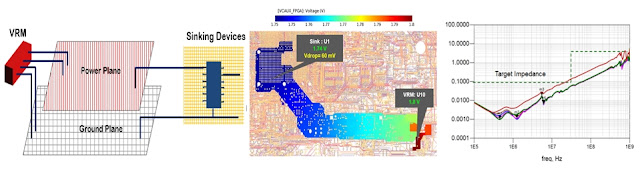
The Emergence of Power Integrity Analysis As the speed of the data signal increases, many reasons including  power supply noise  lead to the degradation of the high-speed signals. In low power high-speed digital interfaces, it is crucial to characterize the whole system power supply in order to minimize power supply noise in the system. High-speed design failures show up as failures at higher operating frequency, data error rates, cross talk errors, and EMI errors. Currently, PI engineers do PI analysis of power system to ensure proper and reliable operation using Electronic Design Automation tools (EDA) before the actual fabrication of board. This reduces board failure chances significantly and also cuts production time. SI and PI are two distinct but related realms of analysis concerned with the proper operation of digital circuits. In SI, the main concern is to make sure that transmitted 1s looks like 1s at the receiver (and same for the 0s). In PI, the main...
Image
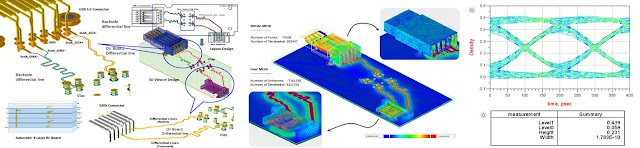
Signal Integrity Analysis of High-Speed Interconnects Signal integrity (SI) addresses two key aspects in high-speed digital designs: signal timing and quality. SI analysis aims to ensure signals reach their destination in good condition. In a system, signals travel through various kinds of interconnections (e.g., from chip to package, package to RF board trace and trace to high-speed connectors), with any electrical impact happening at the source end, along with the transmission path or at the receiving end, which affects both signal timing and quality. Connector performance directly affects system performance and reliability. As a result, designing and modeling connectors for multi-gigabit applications is one of the greatest challenges in high-speed digital applications. When designing high-speed applications, the signal transmission quality is a critical factor. At gigabit speeds, high-speed interconnects must be characterized along with the RF board traces. The ever-increa...