Posts

Showing posts with the label Anil Pandey

MY BOOK : PRACTICAL MICROSTRIP AND PRINTED ANTENNA DESIGN

Image
Practical Microstrip and Printed Antenna Design Book Cover My new book: “ Practical Microstrip and Printed Antenna Design ”, is all set to be released by end of this month (March 2019). The book covers the topic of microstrip antennas from roughly three vantage points: printed antenna fundamentals, antenna design technique, and design of real-world application-based antennas. This comprehensive resource presents antenna fundamentals balanced with the practical design of printed antennas. Microstrip and printed antennas are used in radars, aerospace systems, internet of things (IoT), satellite systems, 5G networks, MIMO, automobiles, and mobile phones. Supported with essential equations and illustrations, this practical book helps evaluate various design aspect of the antenna. Based on several years of my research in antenna design and development for RF and microwave applications, this book offers in-depth coverage of microstrip and printed antenna design methodology for modern a...

QFN Package Simulation

Image
he Quad Flat No-lead (QFN) package is a CSP (plastic encapsulated package) with a copper lead frame substrate. QFN type package is one of the most cutting-edge IC packaging technologies in the electronics. The QFN is a leadless package where electrical contact to the PCB is made by soldering the leads on the bottom surface of the package to the PCB, instead of the conventional formed perimeter gull wing leads. The QFN-type package is known for its small size, cost-effectiveness and good production yields. QFN also possess certain mechanical advantages for high-speed circuits including improved co-planarity and heat dissipation. The QFN has pins on 4 edges of the bottom surface of the package. The QFN can have either a square or rectangle body as well as symmetric or asymmetric terminal patterns. The QFN was introduced to replace the gull wing lead Quad Flat Package (QFP) because the component leads are embedded in the plastic and cannot be bent during handling to insure consistent ...

Power of Power Integrity Analysis in High-Speed Digital Designs

Image
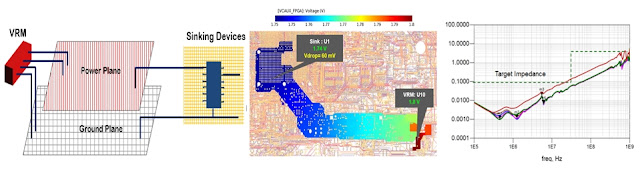
The Emergence of Power Integrity Analysis As the speed of the data signal increases, many reasons including  power supply noise  lead to the degradation of the high-speed signals. In low power high-speed digital interfaces, it is crucial to characterize the whole system power supply in order to minimize power supply noise in the system. High-speed design failures show up as failures at higher operating frequency, data error rates, cross talk errors, and EMI errors. Currently, PI engineers do PI analysis of power system to ensure proper and reliable operation using Electronic Design Automation tools (EDA) before the actual fabrication of board. This reduces board failure chances significantly and also cuts production time. SI and PI are two distinct but related realms of analysis concerned with the proper operation of digital circuits. In SI, the main concern is to make sure that transmitted 1s looks like 1s at the receiver (and same for the 0s). In PI, the main...

How to Select Design and Simulation Software for Antenna Design

Image
The answer to this question depends to a great extent on the particular antenna problem that is to be analyzed. There are various antenna simulation tools based on different numerical techniques. Software for antenna design can be selected based on antenna type and size. Choosing the right technique for solving an antenna problem is important, as choosing the wrong one can either result in incorrect results, or results which take excessively long to compute. Several key EM simulation technologies have emerged over recent years. Out of these, simulation technique the Method of Moments (MoM), Finite Element (FEM) and Finite Difference Time Domain (FDTD) solutions are used almost in all commercial software like Momentum, HFSS, CST, Sonnet, EMPro etc. Although in principal these technologies could be used to solve the same problems there are often good practical reasons why one particular simulator is better suited to solving a particular problem type. There are many considerations...